From Gigha’s vibrant Achamore Gardens to the celebrated Benmore, and the exotic treats of Crarae, Argyll’s gardens are more than just a pretty setting – each has its own story to tell.
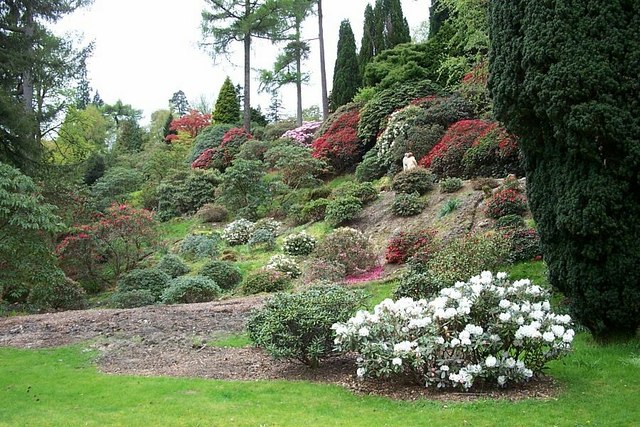
Benmore Botanic Gardens, near Dunoon
It takes a man of passion to make a bold romantic gesture, and it doesn’t get much more romantic than Sir James Horlick’s tribute to his wife, Flora.
In 1931, twenty years after they were married, the war hero, hot drinks tycoon, and compulsive horticulturalist cultivated a new rhododendron, perhaps the finest in an already fine collection, and named in it her honour.
Today, the colourful ‘Mrs James Horlick’ can be seen on display at Achamore Gardens, at the couple’s former home on the Isle of Gigha.
It is a striking, hardy shrub, with eye-catching pink and white flowers that bloom in late spring. More than sixty years after her death in 1952, it remains one of the most popular plants in the collection, and one can’t help but wonder which of its characteristics the woman who inspired it shared.
Achamore Gardens was created by Sir James in the years after the Second World War. It is the jewel in the crown of the little, community-owned island of Gigha (which is a twenty minute ferry trip away from Tayinloan on the Kintyre peninsular).
The London-based baronet bought the estate in 1944, partly to provide a home for the already burgeoning Horlick Rhododendron Collection, and to enable him to grow more delicate species such as the white rhododendron maddennii, in its mild, virtually frost-free climate.
Building the garden was a challenge, but a rewarding one, as Sir James explained at a meeting of the Royal Horticultural Society in 1942. “I can only tell you that creating a garden out of this mess has given me the most enjoyable twenty years of my life, and certainly the busiest.”
Though it is constantly evolving, the site of which Sir James was so proud retains many original plants and features. Its highlights are the sunrise-hued azalea, camellia and rhododendron that he prized, but in the 50 acres of woodland and walled garden, there are plenty other of rare and interesting species to enjoy – thanks partly to a band of local volunteers who help maintain the grounds.
Achamore Gardens is just one of a cohort of spectacular public gardens in Scotland’s west highlands. Scenic hideaways in an already scenic land, their prevalence in this rocky landscape may come as something of a surprise.

Oh help! Oh no! It’s the Ardkinglas Gruffalo
The western highlands are among the wettest, and sometimes stormiest, places in Europe – but visit any village in Argyll in late spring and you wade through the confetti of a hundred bright blooms.
The damp conditions and acidic soil in this rainy tip of Britain team with the warming influence of the Gulf Stream (an oceanic current) to recreate conditions not dissimilar to those found in the Himalayas. Thanks to the sheer pluck of the plant hunters who ventured into uncharted territory to source their plants and seeds, this has become rhododendron country.
The comparison with more exotic locations is particularly apt at Crarae, a National Trust for Scotland garden near Inveraray, on the banks of Loch Fyne, where water cascades down a steep glen bordered with vibrant species native to more humid lands.
Dubbed ‘Scotland’s Himalayan Gorge’, this garden owes more a handful of individual species to the influence of East Asia.
Its creator was Grace, Lady Campbell (the wife of the 5th baronet Archibald Campbell of Succoth) a gifted gardener with a particularly useful family connection – she was the maternal aunt of the audacious botanist Reginald Farrer, who spent much of his career collecting specimens in the mountains of Japan, China, and even Korea and Tibet.
From 1912 on, Lady Campbell began to establish the garden framework, introducing ornamental planting close to the family home at Crarae Lodge, and establishing woodland footpaths, with her famous nephew contributing some of the spoils of his adventures, including alpines, rhododendron and eucalyptus, and almost certainly lending his advice and expertise, particularly with regards to the rock garden, his specialism.
As Lady Campbell worked to exhibit Crarae’s international assets, a few miles west, on the Isle of Seil, a very different garden was set to be created, influenced by events and industry much closer to home.
In the early 1930s, Faith Celli, an English actress well-known for her performances on the London stage, came to Scotland to visit the empty distillery cottage that her husband, the politician and cavalry officer, Colonel Arthur Murray, had inherited.
The bleak coastal site must have seemed very isolated after the whirlwind of London society the wavy-haired Tatler cover girl, star of hit plays such as Dear Brutus and Peter Pan, would have been used to, but perhaps that was exactly she and her husband were looking for.
The Murrays kept the cottage and bought the neighbouring ones as well, and engaged the services of Thomas Mawson, the leading garden designer of the age, to transform what was unkempt hillside, into An Cala, a work of art in which many of the original trees and shrubs, including a mass of flowering cherries and azaleas, still thrive. (An Cala is closed for the 2016 season)
Where some would see the hillside setting as an obstacle, Mawson’s design embraced it, creating a series of terraces which became distinctive mini gardens, each with its own view across the sea to the Hebrides beyond – one was to become a rose garden, another contained a pool.
The Murrays’ arrival on the Isle of Seil came at a challenging time for the area, which had for the previous century been a hub of Scotland’s slate industry. Their garden project not only provided employment for former slate workers, it paid homage to the island’s critical resource, with its paths and the terrace walls made from Easdale slate.
Faith Celli was only to enjoy her garden for a short while, she died in 1942, just after a decade after it had been completed, but her husband, who kept extensive photographic and horticultural records, and subsequent owners, have continued to nurture and develop this exceptional outdoor space.
Scotland’s 20th century gardens owe much to the personalities who threw their energies into creating them, but there are also magnificent woodland gardens with their roots much further in the past, and their ambassadors are characters even more enchanting than those previously described.
Enter the vast Benmore Botanic Gardens, near Dunoon, and you find yourself dwarfed by an avenue of Giant Redwoods – and they are just the start of what this vast garden has to offer. The seeds of these majestic sentries were among the first of their kind to arrive in Britain, more than 150 years ago.
Explore the snaking paths around Ardkinglas Woodland Gardens, at the head of Loch Fyne, and you enter the world of Julia Donaldson’s celebrated picture book, The Gruffalo – the theme for a recently opened trail which has turned an already magical location into an accessible and entertaining family day out.
The fictional characters (a mouse, a fox, a snake and an owl) share their new home with real red squirrels a collection of champion trees, including a Grand Fir which is the tallest in Scotland.
The elder statesman among these trees is the charismatic Abies alba, a European Silver Fir with a girth of nearly ten metres and a remarkable four-trunked form, probably developed as a result of poor early management.
Thought to have been planted in the late 1700s, it was reported as “the mightiest conifer in Europe” back in 1905 – before the first spade sliced peat to create some of the other, now historic, gardens described above.
The remarkable trees of Ardkinglas are overlooked by an inspired recent addition to these gardens that helps put its senior citizens’ worth into perspective. The scriptorium, a gazebo-like structure on the hillside, is made from Argyll Oak, engraved with a selection of stirring quotes, from sources ranging from Spike Milligan to the bible, about trees.
One of the most direct, from Voltaire, reads “Il faut cultiver notre jardin” or “We must cultivate our garden.” It might have been written as a mantra for the West Highlands’ green fingered architects whose labours still bring so much pleasure today.
- Benmore, Crarae and Ardkinglas Gardens are part of the Scotland’s Gardens scheme, which raises money for charity by opening gardens of horticultural interest to the public. www.scotlandsgardens.org


 All about Argyll