Scotland’s woodlands are remarkable places, and they are home to incredible trees – ancient characters whose past is entwined with the communities beneath them. They have survived disease, development and disaster – if only they could talk, what stories they would tell.
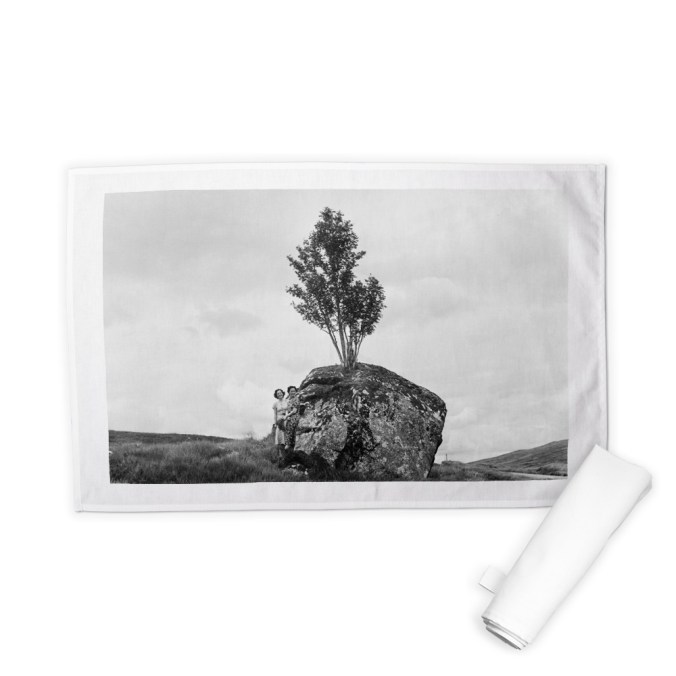
The Rannoch Rowan features on tea towels like this one from vintagephotosonline.co.uk
Some of our most significant trees are the star attractions at public gardens, but others simply stand at the roadside, or rest in a quiet glen.
Below are my favourites, five enchanting heritage trees from in and around the West Highlands.
- The Forestry Commission and Edinburgh Royal Botanic Gardens recently launched a ‘tree trail’ celebrating some of the collections of great trees that can be enjoyed here. Find out more at www.treetrailscotland.com
The Fortingall Yew, Fortingall Churchyard, near Aberfeldy
Thought to be the oldest living thing in Britain, this European Yew dates back to at least Roman times (it is between 1,500 and 3,000 years old) and stands in the churchyard of the Perthshire village, protected only by a small wall.
By the 18th century it was already famous – partly because of the legend that Pontius Pilate was born beneath it – and it suffered considerable damage as locals cut pieces from it to make souvenir drinking cups and bowls to sell. Decay has further split its once enormous trunk into smaller stems so that it gives the impression of being several separate trees.
Abies Grandis, Ardkinglas Woodland Garden, near Inveraray
Scotland’s tallest tree at just over 64m, this Grand Fir has been crowned the tallest in Britain on several occasions, and estate staff hope that with good management it can grow it back to retake the top spot. The towering specimen was planted in 1875, and could have been brought to Argyll by Victorian plant hunters returning from expeditions in the Americas. Its neighbour on the beautiful banks of Loch Fyne is Abies Alba, a four-trunked European Fir with a ten metre girth that dates back to around the time of the Jacobite revolution.
Giant Redwoods, Benmore Botanic Gardens, near Dunoon
The stately Redwoods of Benmore were among the first giant sequoias to be brought to Britain, and celebrated their 150th anniversary last year, making them mere whipper-snappers by the standards of their species, which can live for thousands of years. Though 50 of trees were planted only 49 remain, one was lost in the storms of 1963. The lofty avenue is the showpiece at the entrance to the gardens, and guaranteed to make any mere human strolling below, feel very insignificant indeed.
Argyll Wishing Tree, south of Ardmaddy Castle, near Oban
The only tree on this list that is no longer alive, the Argyll Wishing Tree nonetheless deserves its place, and could be the most magical of all. A hawthorn that grew on a windy hillside (on the cattle drovers’ routes south from Oban), it was thought to be able to grant wishes, and many of those who passed it pressed a coin into its trunk for luck. Research is underway to establish the trees age and more about its age and uses. You can still see its remains – the bark encrusted with discoloured coins – today, though despite conservation efforts it is thought unlikely that the skeleton will last for long.
Horticulture enthusiasts can combine a walk to the tree with a trip to the vibrant Ardmaddy Castle Gardens.
The Rannoch Rowan, Rannoch Moor
A hermit in a desolate and beautiful landscape, this rowan appears to grow right from a boulder. Framed by mountains and sky, its lonely silhouette inspires many motorists crossing the A82 through Glencoe to stop and take photographs (though please take care if you do follow their example, this is a fast road). Its resilience in growing up through a crack in the rock is also the secret of its ongoing survival – the encased and elevated position protects it from the grazing sheep and deer whose appetites so often prevent moorland growth.
 All about Argyll