On a clear day you can see Connel Bridge from over a mile away, its steel twin peaks mirroring the shapes of the mountains behind. It is an impressive feat of engineering and stands astride an even more impressive work of nature, the Falls of Lora.
Britain’s only saltwater or ‘reversing’ rapids, these falls are created when the tidal waters in the Firth of Lorn fall below the level of Loch Etive, causing millions of tonnes of water to pour out through rocky narrows, forming a dramatic tidal race.
The rapids are popular with extreme divers and are so challenging that they are often used for emergency services training, however, you can observe their power from a safe distance from the footpath over Connel Bridge, or the car park opposite the perfectly situated Oyster Inn.
The glacial Loch Etive is also a popular fishing destination – because of the influence of fresh and sea water, its ecosystem is home to species as diverse as spurdogs, rays, cod, mackerel and brown trout.
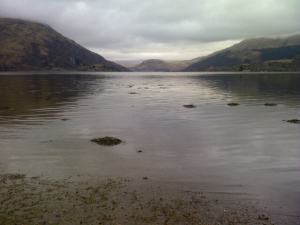
Loch Etive from Taynuilt
To enjoy the view from a different perspective, head north to Connel and the Oban and the Isles airport, which offers connecting flights to many of the Hebrides, as well as aerial tours of the whole of the west Highlands. With Loch Linnhe to the west and views of Loch Etive to the east, even take off and landings are an opportunity to gain new perspective on the geology and geography below.
Neighbouring Benderloch provides easy access to the perfect pebbly crescent of Tralee beach, and is the start of a choice of routes to stroll or cycle near the shores of Loch Creran. From here, you can access the developing Sustrans cycle path between Oban and Fort William.
If you prefer an elevated view, Benderloch (south of the petrol station) is also the starting point for a hike up Ben Lora – a 308m challenge whose reward is a panorama of the Firth of Lorn.
At Barcaldine, a giant octopus, inquisitive otters and playful seals are among the permanent residents who will meet you the Scottish Sea Life Sanctuary, an aquarium and rescue centre for injured and abandoned marine animals.
Appin and Lismore
A wooden structure crossing open marshland, Appin’s charming Jubilee bridge does not appear to be going anywhere much (it was built over a century ago to give villagers easy access to church) but that doesn’t prevent the urge to set foot on the boardwalks and cross it, just enjoy the experience and the remarkable views.
Crossing Loch Laich, in the shadow of Castle Stalker, the celebrated, recently restored bridge, is just one attraction of the tiny village, whose tranquillity and exquisite setting conceals its connection to one of Scotland’s most famous murders.
The Appin murder, the inspiration for Robert Louis Stevenson’s novel Kidnapped, happened over 250 years ago, but the mystery surrounding it continues to inspire and intrigue today.
In 1752, Colin Campbell, a land agent, was shot in the back as he rode through woods near Duror. The government set out to make an example of his assassin and wrongfully convicted and hung James Stewart, a local farmer, whose remains were to dangle at the Ballachulish bridge for four years after his execution.
The history of the Stewart clan is interwoven with the Appin scenery, most strikingly at Castle Stalker itself, a landmark familiar from its appearance as Castle Aaargh in the closing scenes of Monty Python and the Holy Grail (1975).
The castle was built by John Stewart in the fifteenth century only to be lost by the 7th Stewart chief 300 years later through a drunken bet in which he exchanged the family stronghold for an eight-oared boat.
There are good views of the castle from Portnacroish or the road to Port Appin, and although tides mean that it is only occasionally accessible, tours are sometimes possible.
Across the loch, the island of Lismore claims its own ancient origins. An early Christian settlement was founded there by St Moluag, who, legend has it, staked his claim to the island in a coracle race against St Columba. Columba was narrowing ahead as they neared the shore, so Moluag, desperate to claim the land, cut off his own little finger with an axe and threw it on to the shore – ensuring that at least a part of him reached the island first.
The island’s gaelic name ‘Lios Mor’ meaning ‘great garden’ is an apt one, particularly once the fuchsias which decorate every hedgerow bloom – though the fertility of its soil may owe less to an infusion of saintly blood than to its limestone base and temperate climate.
Lismore can be reached by a car ferry from Oban, but the little passenger ferry from Port Appin offers a more intimate experience and with an abundance of wild flowers, the island lends itself to a close-up exploration on foot or bike.
Getting there: From Oban follow signs for Connel, then take the A828 towards Fort William. From Glasgow, head to Oban, then take the A828 at Connel. Hourly buses leave from outside Oban train station, signed for Fort William or Barcaldine, with stops along the route.
 All about Argyll