From atmospheric castles to spectacular abbeys and majestic stately homes, the ancient buildings of Scotland are as integral to the country’s heritage as tartan and the bagpipes – and the West Highlands is home several of the most magical sites.
While a visit to one of the area’s celebrated structures, such as Castle Stalker, Eilean Donan Castle or Mount Stuart, will provide a memorable experience, the countryside is also home to less well known, but no less captivating buildings – each with their own charm and stories to tell.
Below, we have picked out a handful of our favourite tucked away treasures. Most, though not all, of these castles and places of worship are ruins, and while a little exploration may be necessary to reach some, others perch unobtrusively at the roadside, so you won’t even need to take a detour to see them.
Castles
Kilchurn Castle, near Dalmally
A striking ruin in a stunning setting, it is no wonder that Kilchurn is one of Scotland’s most photographed castles, though wider fame still eludes it.
Set against rolling hills at the north-east end of Loch Awe, its boasts striking views of the loch and surrounding landscape and plenty of local wildlife. The entrance is unmarked and surprisingly well concealed – which only adds to the sense of having discovered a local secret when you reach your destination.
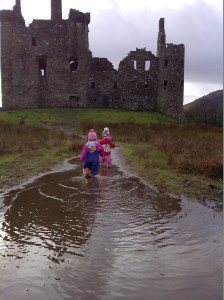
Kilchurn Castle, Dalmally
In summer most of the castle is open, and, with climbable turrets and a huge fire place to stand in and shout up, it makes an ideal hands-on experience for families.
The fifteenth century fortress initially comprised a five story tower, built by the powerful Campbells of Glenorchy. It was adapted and added to in subsequent centuries, including in the late 1600s when it was used as a Government garrison during the Jacobite rebellion.
Find it: Though there are good views of Kilchurn from Loch Awe Village and the A819, access to the castle’s makeshift car park is marked only by two white bollards shortly after the junction for Inveraray, between Dalmally and Loch Awe on the A85. From the car park, the castle itself is a scenic walk of about a quarter of a mile.
Entry: free (site open year round, but inside only accessible from April to September)
Gylen Castle, Isle of Kerrera
A dramatic silhouette dominating the southern tip of the Isle of Kerrera, near Oban, a visit to the ruined Gylen Castle more than repays the determination it takes to reach it.
Built in 1582, the stronghold was critical for the MacDougall clan, who had it strategically positioned to overlook the southern approaches to their Oban base.
The castle was only occupied for around six decades, and was subject of a siege in 1647, when the royalist residents were defeated by covenanter forces. Though its defences could not be penetrated, the occupants eventually surrendered due to lack of water, and Gylen was burned and never occupied again.
Even before recent restorations, which have repaired the oriel window and vaulted cellar, Gylen attracted admirers, including the painter Joseph Turner, who sketched it several times during a tour of the Hebrides in 1831.
Find it: Kerrera can be reached via a two-minute trip on a small passenger ferry, departing from a slipway signed from the south of Oban (not the main CalMac ferry terminal). The castle is well signed and about an hour’s moderate walk from the island’s pier.
Entry: free
Carnasserie Castle, Kilmartin
A relative youngster compared with the prehistoric edifices and artefacts that litter the remarkable glen it overlooks, at over 400 years old, Carnasserie Castle still has a rich past to reveal.
The angular 16th century ruin, set on a wooded hilltop just north of the Kilmartin village, was built in 1565 by the reforming protestant bishop John Carswell. It passed into the hands of local members of the Campbell clan and was blown up by the king’s forces in 1685 in response to its owners’ support for the Monmouth rebellion. Though it was not repaired, much of the structure, including the walled courtyard garden, remains intact.
The castle is notable for its accomplished architecture, particularly the ground-breaking combination of a five storey tower house and a three storey hall, and intricate masonry, with finely carved features such as the front door frame and decorated rainwater spouts worth seeking out.
Find it: Carnasserie Castle is signed two miles north of Kilmartin off the A816. The building is an uphill walk of a few minutes from the car park.
Entry: free (open year round)
Churches
St Blane’s, near Rothesay, Isle of Bute
The surrounding island may have transformed in the centuries since St Blane’s chapel was built, but you only have to glance at the sea views, towards Arran and the Holy Isle, to appreciate what inspired its founders to build a place of worship at the site.
Located in a sheltered spot at the southern tip of the Isle of Bute, the ruins of St Blane’s, some of which date back to the 1200s, are extensive and well preserved. Highlights include the nave and chancel, and a collection of Norse grave slabs.
The church, which at one point served the whole island, was built on the site of a monastery believed to date back to the 6th century.
Find it: St Blane’s is located two miles south of Kingarth. The church is a short, well-signed walk from the car park.
Oronsay Priory, Isle of Oronsay (near Colonsay)
As remote as it is dramatic, the windswept 14th century priory on the Isle of Oronsay was once a bustling religious centre, home to a community of monks dedicated to St Columba.
It takes something of a pilgrimage to reach the restored ruins today – when the tide is out you can walk to Oronsay from the neighbouring Isle of Colonsay – but the effort only serves to enhance appreciation of the well-preserved site, where church, cloister, chapter house and refectory remain interesting and identifiable.
An exquisitely carved medieval cross is the priory’s showpiece, with gravestones among other fine examples of the work of early masons.
Find it: Regular ferry services run to Colonsay from Oban, and neighbouring Islay. Oronsay, to the south of Colonsay, is a tidal island. Seek local advice on safe times to cross.
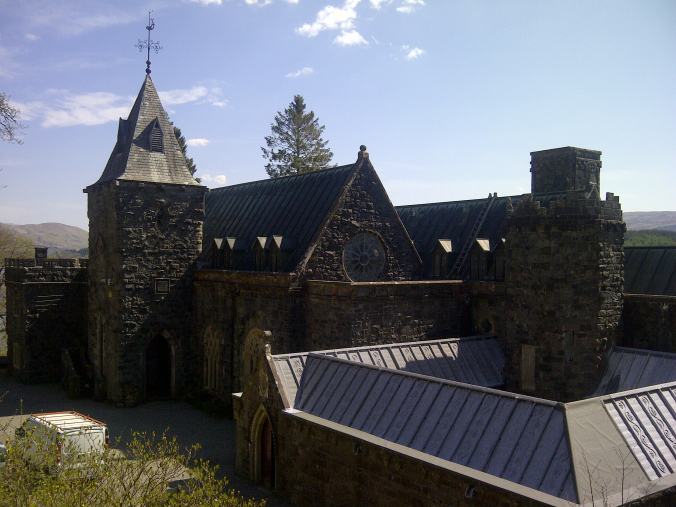
St Conan’s Kirk, Loch Awe
A still active local church with a remarkable history and setting, St Conan’s Kirk, on the banks of Loch Awe, is only a century old, but combines and emulates an appealing range of architectural styles.
The building was a passion project for Walter Douglas Campbell, who is said to have conceived it to provide a place of worship close to home for his mother, with whom he lived on the nearby island of Innischonan.
Its internationally influenced design grew well beyond the scope of a conventional parish church, with the steep and elaborate south side a particular foil for its creator’s imagination. Notable features include the pillars and arches of the rounded apse and aisle, the Iona-inspired window chapel, the patterned lead roof of the Cloister Garth, and gargoyles of dogs and hares on the roof.
Work on St Conan’s Kirk began in 1907, and was continued by Campbell’s sister Helen after he died in 1914. However, it was stalled by the First World War, and then by her own death in 1927, so the church was not used for worship until 1930.
Though this atmospheric building’s beauty is maintained thanks to local volunteers, it is in desperate need of renovation, particularly to the roof, exterior stonework, woodwork and ironwork. Fundraising towards these costs is underway.
Find it: St Conan’s Kirk is on the A85 in the centre of the village of Loch Awe. There is roadside parking before and after the church.
 All about Argyll